
◆Download link for brochure
https://smart119.biz/manga/000291.html
◆Theme
The correct understanding of COVID-19 mRNA vaccines explained by emergency and intensive care physicians and infectious disease specialists
◆Commentator
Taka-aki Nakada
Representative Director, Smart119 Inc.
Professor, Department of Emergency and Intensive Care Medicine, Chiba University Graduate School of Medicine
https://twitter.com/Nakada119
Toshifumi Taniguchi
Lecturer, Department of Infectious Diseases, Chiba University Hospital
https://twitter.com/tosh_taniguc
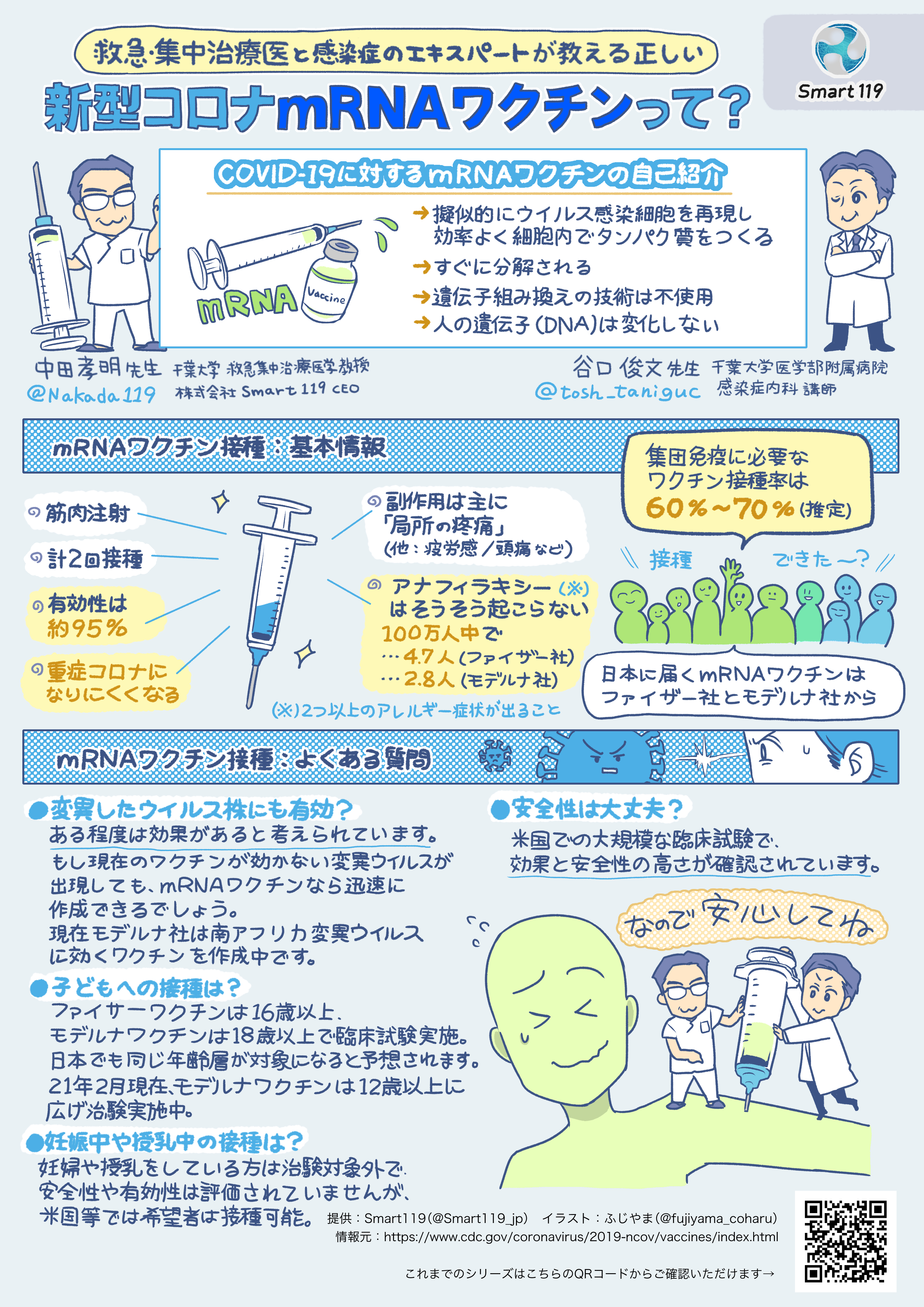
◆Key point 1: What is mRNA against COVID-19?
-It reproduces virus-infected cells and efficiently makes proteins in the cells.
-It is degraded quickly.
-The vaccine is produced without the use of genetic recombination technology.
-The vaccine is produced without the use of genetically modified technology.
-It does not act on or alter human genes (DNA).
◆Key point 2: Basic information on mRNA vaccination
-Intramuscular injection.
-Two doses in total.
-Side effects are mainly "local pain". Others are fatigue or headache etc.
-Efficacy is 95%.
-Less likely to cause serious infections.
-Anaphylaxis (the development of two or more allergies) is not common.
Pfizer: 4.7 out of 1 million patients.
Moderna: 2.8 out of 1 million people.
-The vaccination coverage required for herd immunity is estimated to be 60-70%.
◆Key point 3: Frequently asked questions about mRNA vaccination
Q. Is the vaccine effective against mutated virus strains?
A. It is expected to be effective to some extent.
Q. Is it safe?
A.It has been confirmed to be highly effective and safe in a large-scale clinical trial in the United States.
Q. Is it possible to inoculate children?
A.According to Pfizer and Moderna clinical trials, the following age groups are expected to be vaccinated
Pfizer: 16 years and older.
Moderna: 18 years and older. (As of February 2021, Moderna is conducting clinical trials with a target age range of 12 years and older.)
Q. Is it safe to take the vaccine while pregnant or breastfeeding?
A. Pregnant and lactating women have not been evaluated for safety and efficacy because they are not eligible for clinical trials, but in the United States, vaccination is available for those who wish.