
Smart:DR was featured in the March 20, 2021 issue of the Kyushu Medical Journal.
Smart:DR is a disaster countermeasure system developed for medical institutions and is equipped with a "staff health information management function" including the input of "post-vaccination side reactions". Medical staff who have been vaccinated are now required to keep a health observation logbook, but this system reduces the burden by eliminating the need to fill in and store paper forms. The system will also contribute to data collection on signs of adverse reactions after vaccination by collecting data on body temperature and physical condition, which are entered daily by many staff members.
◆About "Smart:DR," a disaster response system for medical institutions
-Easy input of health information, efficiency of aggregation and centralized management with little effort-
Every day at a certain time, a notification with the URL of the questionnaire form will be sent to the staff's smartphones or other devices via LINE or e-mail. The staff member selects their temperature, physical condition, and attendance status from the screen and replies with a single click (Patent Registration No. 6166114). The replied data is stored in the server and automatically managed centrally. This eliminates the need to fill out and submit forms and input data into a PC, making health management more efficient.
-Functionality based on a thorough understanding of the medical field-
In the case of staff members who have tested positive and have been placed on home leave, the "Staff Health Management Function" can be used to grasp their recent work status and extract candidates for intensive contact within the hospital based on detailed body temperature information. The system provides items based on a medical point of view to aggregate and manage high quality health information and prevent clusters from occurring.
-Ability to respond to emergencies during disasters and flexibility of implementation-
The system provides centralized management to expedite emergency response in the event of a large-scale disaster (e.g., confirming the safety of staff, convening a limited number of DMATs, etc., and assigning personnel to first-aid stations). The system flexibly responds to regulations and emergency measures that vary from medical institution to medical institution, and provides an optimized system. The system is designed with a view to smooth transition of operations while utilizing existing systems.
◆Introduction of the "Smart:DR" disaster countermeasure system for medical institutions
Smart:DR" was developed as a disaster countermeasure system for medical institutions to support information sharing and redeployment of personnel to emergency sites in the event of a disaster, terrorist attack, or other emergency. The system has already been introduced at Shimane University Hospital and Rinku General Medical Center, and the Osaka Acute and General Medical Center has tested the effectiveness of the "Staff Health Management System" to centrally manage the health status of its staff, demonstrating its effectiveness in preventing cluster outbreaks.
Health Management DX after New Corona Vaccination] Trial operation at Osaka Acute and General Medical Center started on March 8.
https://prtimes.jp/main/html/rd/p/000000028.000056624.html
Rinku General Medical Center Begins Using Adverse Reaction Check and Health Management System after New Corona Vaccination
https://prtimes.jp/main/html/rd/p/000000030.000056624.html
Kyushu Medical Journal
https://k-ijishinpo.jp/
◆Document Download Link
https://smart119.biz/manga/000300.html
◆Theme
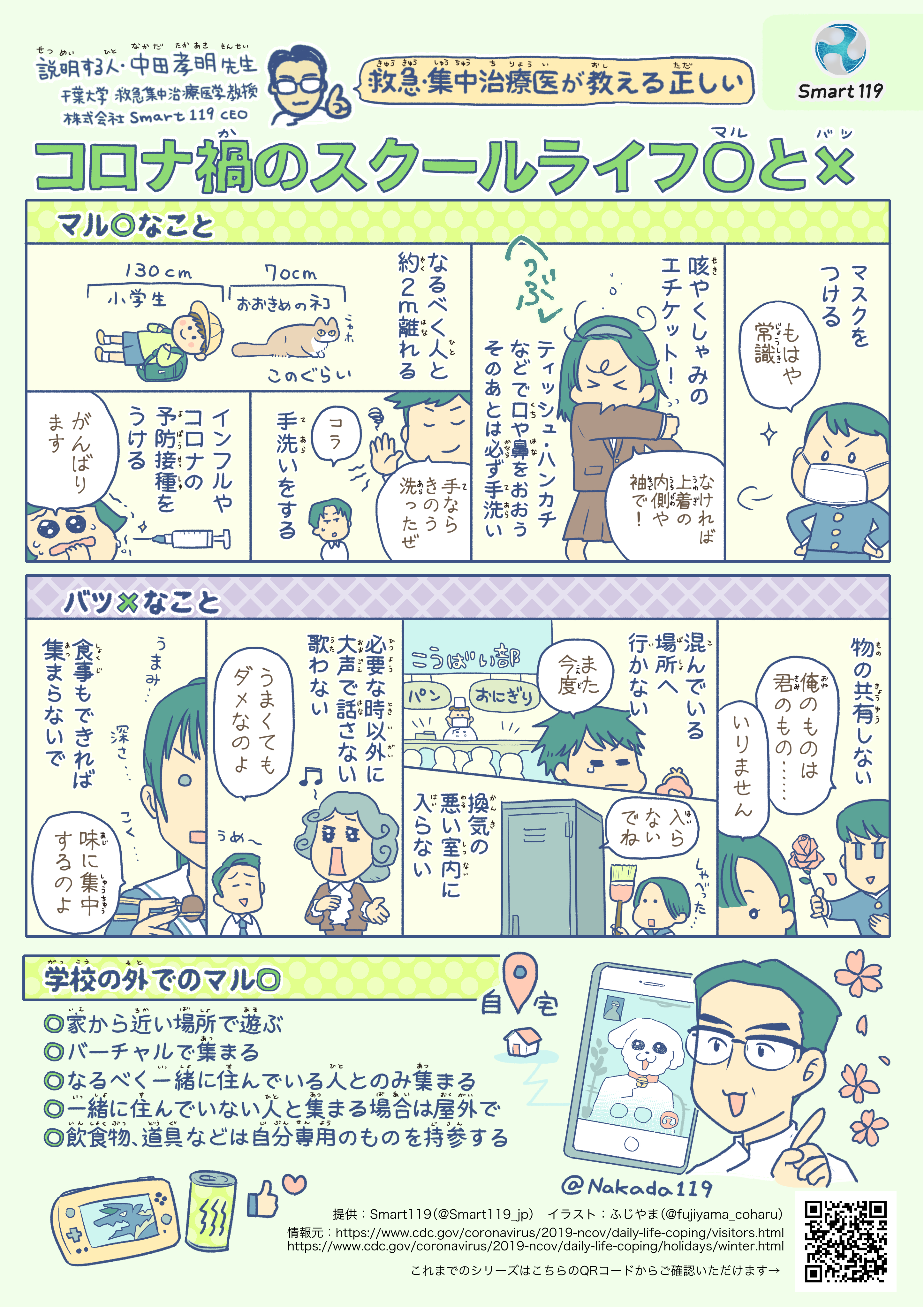
"Dos (○) and Don'ts (×) in school life under Covid-19 pandemic"
◆Commentator
Taka-aki Nakata, Professor, Department of Emergency and Intensive Care Medicine, Chiba University
◆Point 1: Things you can/should do on campus (○)
・Keep about 2 meters away from people as much as possible.
・Get vaccinated against influenza and new coronaviruses.
・Wash your hands frequently.
・When coughing or sneezing, cover your mouth and nose with a handkerchief and wash your hands afterwards.
・Wear a mask.
◆Point 2: What to be careful about on campus (x)
・Do not gather in classrooms or cafeterias for lunch, as this is the same as having a dinner party.
・Do not sing or talk loudly at karaoke or other gatherings.
・Do not go to crowded places.
・Do not enter poorly ventilated rooms.
・Do not share things.
◆Point 3: Things you can/should do off campus (○)
・Play in places close to home.
・Get together virtually.
・If possible, get together only with people you live with.
・If you want to get together with people you don't live with, do it outdoors.
・Bring your own food, drink, tools, etc.
<Background of the project>
Voices from the field of education
・Difficult terms and abbreviated words are difficult for students to understand, and it is difficult to teach them how to prevent infection.
・It is difficult to teach students how to prevent infection.
・We believe that one of the reasons for the spread of infection is that children and students develop misunderstandings in this situation and are not taking preventive actions.
In making this film from the medical front
・Focus on what should be communicated to students, such as what they should be careful about in school life.
・Replace the word with something that can be experienced in school life.
- "Restaurant meetings": An image of an evening restaurant or drinking meeting that involves serving customers → Lunch scene at school.
- "Lunchtime karaoke": An image of karaoke during the daytime when elderly people gather → A scene of karaoke after school.
- "3 mitsu": Only the word is used and the image of the content is not clear → close, dense, and hermetic should be noted.
In the "Medical Knowledge Manga Series" provided by Smart119, we have covered how to wear a mask, mental care, and countermeasures against new coronavirus infections in restaurants, based on the insights of emergency and intensive care physicians and medical professionals. This information is already being used effectively in many public institutions. We have received many requests from educational institutions such as universities, kindergartens, and elementary, junior high, and high schools to adopt measures to prevent infectious diseases in school life before the spring season for entering and moving up to higher education.
In the media coverage of infectious disease prevention, there is a tendency that students do not understand the content correctly because of medical terminology and the word "kaishoku" which is associated with "meetings where there is entertainment and drinking. Against this background, educational institutions are finding it difficult to provide educational guidance on infection prevention.
This work is divided into "good things" and "things to be careful about" in the school life of coronary heart disease, and teaches how to lead a healthy school life with friendly cartoons and plain words.
Rinku General Medical Center, which uses the "Smart:DR" disaster countermeasure system for medical institutions, began vaccinating approximately 1,000 of its employees against COVID-19 on March.
On March 11, the following day, a function to centrally manage the occurrence of adverse reactions was put into operation by requesting staff who had been vaccinated to report their body temperature, physical condition, and attendance status through "Smart:DR" installed on their mobile devices.
Smart:DR is a disaster countermeasure system developed for medical institutions, and is equipped with a "staff health information management function" that includes the input of "post-vaccination precautions". Medical staff who have been vaccinated are now required to keep a health observation logbook, but this system reduces the burden by eliminating the need to fill in and store paper forms. The system will also contribute to data collection on signs of adverse reactions after vaccination through data collection of body temperature and physical condition information entered daily by a large number of staff.
For more details, please refer to the press release below.
Rinku General Medical Center Begins Using the Adverse Reaction Check and Health Management System after COVID-19 Vaccination
https://prtimes.jp/main/html/rd/p/000000030.000056624.html
Translated with www.DeepL.com/Translator (free version)
◆Download link for brochure
https://smart119.biz/manga/000291.html
◆Theme
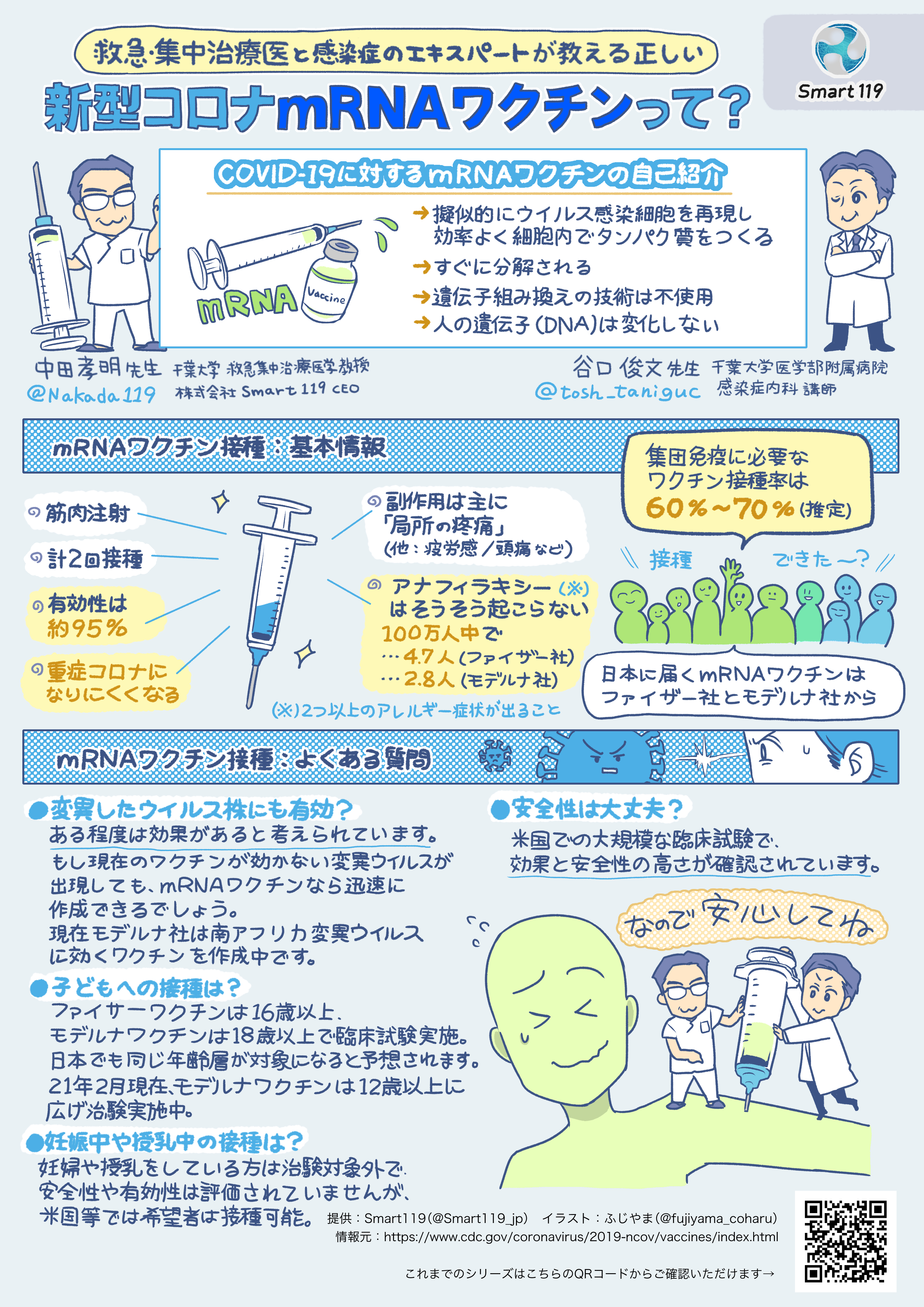
The correct understanding of COVID-19 mRNA vaccines explained by emergency and intensive care physicians and infectious disease specialists
◆Commentator
Taka-aki Nakada
Representative Director, Smart119 Inc.
Professor, Department of Emergency and Intensive Care Medicine, Chiba University Graduate School of Medicine
https://twitter.com/Nakada119
Toshifumi Taniguchi
Lecturer, Department of Infectious Diseases, Chiba University Hospital
https://twitter.com/tosh_taniguc
◆Key point 1: What is mRNA against COVID-19?
-It reproduces virus-infected cells and efficiently makes proteins in the cells.
-It is degraded quickly.
-The vaccine is produced without the use of genetic recombination technology.
-The vaccine is produced without the use of genetically modified technology.
-It does not act on or alter human genes (DNA).
◆Key point 2: Basic information on mRNA vaccination
-Intramuscular injection.
-Two doses in total.
-Side effects are mainly "local pain". Others are fatigue or headache etc.
-Efficacy is 95%.
-Less likely to cause serious infections.
-Anaphylaxis (the development of two or more allergies) is not common.
Pfizer: 4.7 out of 1 million patients.
Moderna: 2.8 out of 1 million people.
-The vaccination coverage required for herd immunity is estimated to be 60-70%.
◆Key point 3: Frequently asked questions about mRNA vaccination
Q. Is the vaccine effective against mutated virus strains?
A. It is expected to be effective to some extent.
Q. Is it safe?
A.It has been confirmed to be highly effective and safe in a large-scale clinical trial in the United States.
Q. Is it possible to inoculate children?
A.According to Pfizer and Moderna clinical trials, the following age groups are expected to be vaccinated
Pfizer: 16 years and older.
Moderna: 18 years and older. (As of February 2021, Moderna is conducting clinical trials with a target age range of 12 years and older.)
Q. Is it safe to take the vaccine while pregnant or breastfeeding?
A. Pregnant and lactating women have not been evaluated for safety and efficacy because they are not eligible for clinical trials, but in the United States, vaccination is available for those who wish.
We have added a function to manage health information after vaccination to the disaster countermeasure system for medical institutions "Smart:DR". The system will be installed in the Osaka Acute and General Medical Center, and trial use will start on March 8th.
With the start of the vaccination of healthcare workers against the new coronavirus infection, approximately 20,000 people will be required to keep a health observation logbook, and it will be necessary to collect and report the contents written on paper in an analog manner.
We have updated the existing disaster countermeasure system for medical institutions, "Smart:DR", which has a "staff health information management function", to add "post-vaccination value" in order to reduce the burden on the busy medical staff and to enable correct data to be collected as soon as possible.
By using this system, it is possible to streamline health management operations by eliminating the steps required for filling out and submitting documents and entering data into a PC.
For details, please refer to the press release below.
【Digital transformation of health management after vaccination against COVID-19】
Trial operation at the Osaka Medical Center for Acute and Comprehensive Care started on March 8